
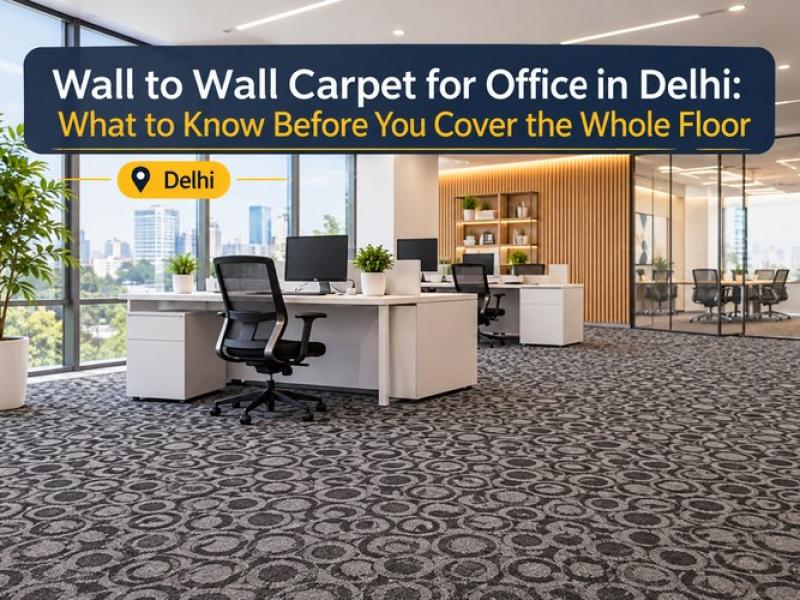
Walk into a newly fitted office in Delhi and you can tell within ten seconds whether the floor was planned or just “done”. Planned floors feel calm. Phones ring, chairs roll, people talk, and the room still doesn’t echo back at you.
That quiet is the real payoff of wall to wall carpet for office in Delhi projects done properly. It’s also a purchase where small decisions, like pile type, backing and how the base is prepared, decide whether the carpet looks sharp in year five or tired in year one.
This guide is for office owners, admin heads and fit-out managers who are still deciding. No jargon wall, just what we’ve picked up while fitting office carpet flooring in Delhi NCR, mostly from fixing other people’s avoidable mistakes.
What wall to wall really means
Wall to wall carpet is one continuous carpet laid across the whole room, edge to edge, and finished neatly at the skirting. It usually comes in wide rolls and is cut and fitted on site, so you get very few visible joins. Think of it as the opposite of loose rugs or squares laid in a grid.
For a reception, a conference room or an open-plan bay, that unbroken surface is exactly why people like it.
Why Delhi offices keep choosing it
We hear the same reasons again and again:
- It cuts noise. Hard floors bounce sound around. Carpet soaks it up, which matters in open-plan teams and call-heavy sales floors.
- It feels better in winter. Anyone who has stepped onto cold vitrified tile on a January morning knows why.
- It hides everyday dust better than glossy floors. Dark polished tiles show every footprint. A good mid-tone carpet forgives a lot.
- It looks finished. A seamless floor makes cabins, corridors and meeting rooms feel like one planned space rather than separate rooms stitched together.
On large areas, it’s often more economical than carpet tiles. Not always, but often, since there’s less handling and fewer pieces to lay.
Wall to wall carpet vs carpet tiles: a quick, honest comparison
This is the question we get most. Neither is “better”. They suit different offices.
| Wall to wall carpet | Carpet tiles | |
|---|---|---|
| Look | Seamless, uniform | Grid pattern, can mix colours |
| Best for | Large open floors, cabins, conference rooms | Offices that want easy replacement of worn patches |
| Repairs | Patch repair possible, but needs a skilled fitter | Swap a single tile |
| Installation | Needs careful seaming and stretching or gluing | Faster to lay, more joints |
| Typical choice when | You want a clean, continuous finish | Furniture shifts often or spills are likely |
Many of our clients actually use both: broadloom in the main bay and cabins, and carpet tiles in pantry-adjacent or high-spill zones. Mixing is perfectly normal.
Loop pile or cut pile for an office?
This trips up a lot of first-time buyers, so here it is plainly.
Loop pile carpet is made of tiny uncut yarn loops. The surface is firm, flat and tight, which is why it handles rolling chairs and constant footfall well. It’s the usual choice for commercial carpet for office use.
Cut pile has the loops snipped open, giving a softer, plusher feel. It looks lovely in a director’s cabin or a boardroom, but shows footmarks and vacuum lines more easily. If that’s the look you want, take a peek at our cut pile carpet range and keep it to low-traffic rooms.
Our rule of thumb: loop pile for the busy areas, cut pile only where people walk less and sit more.
6 things to check before you approve a sample
1. Pile density, not just pile height. A tightly packed pile bounces back after chairs and footfall. A thin, open one flattens and looks worn quickly. Press your thumb in and see how fast it recovers.
2. The fibre. Nylon is known for resilience. Polypropylene is common in budget loop pile and cleans well, but can crush sooner under heavy traffic. Ask what you’re actually getting and don’t settle for “best quality”.
3. The backing. This is the part nobody looks at and everyone pays for later. A stable backing keeps the carpet flat and stops edges curling at seams.
4. Colour and pattern. Pure black and very light beige are the hardest to live with. Melange, speckled or mid-tone shades hide dust and stains far better. For an office carpet design that ages well, go for texture over a flat solid colour.
5. Special needs. Server rooms and electronics areas may need anti-static properties. Larger or public-facing offices may have fire-safety requirements. Raise these at the start, not after the order.
6. Look at it in your own space. Showroom lights flatter everything. Take a sample to your site and check it near the window, under your actual office lighting, and again in the evening.
Delhi-specific things nobody puts in the brochure
Carpet behaves differently here than it does in a brochure photo.
Dust. Delhi’s fine dust arrives on shoes every single day. An entrance mat or a walk-off zone near the door saves the main carpet more wear than anything else you’ll do.
Monsoon humidity. If the base slab is damp, carpet will smell and can lift. A good installer tests moisture first. If they don’t ask about it, that’s a warning sign.
Air-conditioning. Offices here run AC almost all year, which keeps indoor humidity steady and carpet happy. But if a floor stays shut for weeks with no airflow, it can turn stale.
Old, uneven floors. Many buildings in areas like Pitampura, Netaji Subhash Place and Rohini have older cement or tiled bases. Uneven spots show through carpet within weeks, so levelling is rarely optional.
How installation actually goes
A decent wall to wall carpet installation isn’t complicated, but every step matters:
- Site visit and measurement. Someone should see the space, not just quote from a WhatsApp photo.
- Base check and preparation. Moisture, levelling, cleaning. This decides how long the carpet lasts.
- Underlay, if needed. Adds comfort and some sound absorption, but not every office needs it.
- Cutting and fitting. Rolls are planned to keep seams out of walkways and the pile running in one direction, otherwise shades look different from different angles.
- Seaming and edge finishing. Clean joins at doorways, neat edges at skirting.
- Final trim and cleaning. Leftover offcuts should be kept for future patch repairs.
Always keep a small percentage extra for cuts and later repairs. It costs less now than hunting for a matching batch in two years.
At Flooring Studio by Floory Enterprises, we work from our showroom in Pitampura and fit across Delhi NCR. We usually begin with the space itself: how many people, where chairs roll, where the pantry is. Then we suggest a carpet that suits it, even when that means a simpler option than the client first asked for.
What changes the quote (and why two quotes never match)
You’ll get different quotes for the same office. That’s normal, but check what’s behind the difference:
- Fibre type and pile density
- Backing quality
- Whether underlay, adhesive, levelling and skirting are included
- Area size and how many rooms, doors and cut-outs there are
- Wastage allowance
- Installation timing, for example after-hours work in an occupied office
Comparing a rate per sq ft without comparing these is how people end up with a “cheap” carpet that costs more after a year. Ask for a written breakdown, and if you want a quick sense of rough numbers for your space, check our wall to wall carpet for office in Delhi page and send us your area details.
Looking after it so it lasts
Don’t overthink this. Three habits do most of the work:
- Vacuum high-traffic paths daily and the rest weekly. Grit is what actually wears carpet down.
- Treat spills quickly. Blot, don’t rub. Rubbing pushes the stain deeper.
- Deep-clean once or twice a year, depending on footfall, using a method suited to your fibre. Harsh chemicals can fade colour and weaken the backing.
Mistakes we see again and again
- Picking a home-grade carpet for a busy commercial area to save money upfront
- Choosing a shade from a phone screen
- Ignoring the base and then blaming the carpet
- Putting carpet in a spot that gets constant water, such as directly outside a washroom or in a pantry
- Not asking who actually fits it, and whether they’ve done offices before
One more honest note: carpet isn’t right for every corner. For wet or very heavy-wheel areas, hard flooring may serve you better. We’ve covered that side in our guide to commercial PVC flooring suppliers in Delhi, which is useful if you’re planning a mixed-material fit-out.
Quick FAQs
Is wall to wall carpet a good idea for an office in Delhi?
Yes, in most dry interior areas. It reduces noise, adds comfort and gives a clean, professional finish. It works best when the base is dry, level and the carpet is commercial grade.
Which is better for offices, loop pile or cut pile?
Loop pile is generally the safer pick for busy offices because it’s firmer and handles chairs and footfall well. Cut pile suits quieter, low-traffic rooms.
How long does a wall to wall carpet last in an office?
It depends on traffic, fibre quality, installation and upkeep. A good commercial carpet that’s properly fitted and regularly vacuumed can serve an office for many years.
Can carpet be installed without shutting the office?
Often, yes. Work can be done in phases or after working hours. Discuss this before you confirm the order so the schedule suits your team.
Do I need to level the floor first?
In most cases, yes. Uneven cement or old tile shows through the carpet quickly, so base preparation is worth doing.
Should I choose wall to wall carpet or carpet tiles?
Choose broadloom for a seamless look across large areas. Choose tiles if you want simple replacement of damaged sections. Many offices use both.
Planning an office floor in Delhi?
Tell us your area, how the space is used and your timeline, and we’ll suggest options that genuinely fit, with no pressure to buy. You can visit the Floory Enterprises showroom in Pitampura to see and feel samples in person, or contact us here to arrange a site visit anywhere in Delhi NCR.